English

0%

Table of Contents

Vortex casing represents a pivotal advancement in fluid handling across diverse industries. Its unique design facilitates efficient fluid separation and conveyance, minimizing energy loss and maximizing operational performance. From power generation and wastewater treatment to chemical processing and oil & gas, the demand for robust and efficient vortex casing solutions is steadily increasing. Understanding the principles behind vortex casing is crucial for engineers, plant managers, and anyone involved in optimizing fluid flow systems.

The global market for vortex casing is experiencing significant growth, driven by factors such as stringent environmental regulations, the need for increased energy efficiency, and the expansion of industrial infrastructure in emerging economies. According to recent reports, the industry is projected to reach [Insert Statistic - e.g., $X billion] by [Insert Year] with a CAGR of [Insert Percentage - e.g., Y%]. This growth underscores the critical role vortex casing plays in supporting sustainable industrial practices and addressing global challenges related to water management and energy conservation.

Investing in a deeper understanding of vortex casing technologies offers a multitude of benefits. It allows for the optimization of existing systems, the design of more efficient new infrastructure, and the reduction of operational costs. Moreover, proper implementation of vortex casing solutions contributes to environmental sustainability by minimizing waste and maximizing resource utilization.
Advancements in Vortex Casing Technology for Efficient Fluid Handling Systems

Introduction to vortex casing

Advancements in Vortex Casing Technology for Efficient Fluid Handling Systems

Vortex casing, in its essence, is a specialized component designed to create and manage a swirling flow pattern within a fluid system. This engineered vortex action is instrumental in separating solids from liquids, enhancing mixing, and optimizing energy transfer. The efficient utilization of the rotational kinetic energy inherent in the vortex contributes to improved system performance and reduced operational costs.

The widespread adoption of vortex casing stems from its versatility and ability to address a range of fluid handling challenges. It is a core component in many industrial processes, and a growing emphasis on sustainable practices makes it an even more critical technology for the future. Understanding the intricacies of vortex casing allows for the development of more efficient and environmentally responsible solutions.

Defining Vortex Casing

Simply put, vortex casing is an engineered enclosure that promotes the formation of a vortex – a swirling, rotating flow of fluid. This isn’t simply chaotic turbulence; it’s a carefully controlled phenomenon used for specific purposes. The casing’s geometry, specifically its inlet and outlet configurations, dictates the vortex’s strength, stability, and effectiveness.

Vortex casing isn’t a standalone technology, but rather an integral part of a larger system. It often works in conjunction with pumps, separators, and other fluid handling equipment. Its application is tied directly to modern industry’s needs for optimized fluid processing, contributing to everything from cleaner water to more efficient power generation.

The design of the vortex casing is tailored to the specific fluid properties and operational requirements. Factors such as viscosity, density, and flow rate all influence the optimal casing geometry and vortex characteristics. Proper design ensures maximum efficiency and minimizes energy losses.

Key Characteristics of vortex casing

One of the most important characteristics of vortex casing is its ability to enhance separation efficiency. By creating a centrifugal force, the vortex separates solids from liquids based on density differences. This is particularly valuable in applications such as wastewater treatment and oil-water separation, offering a cost-effective alternative to traditional methods.

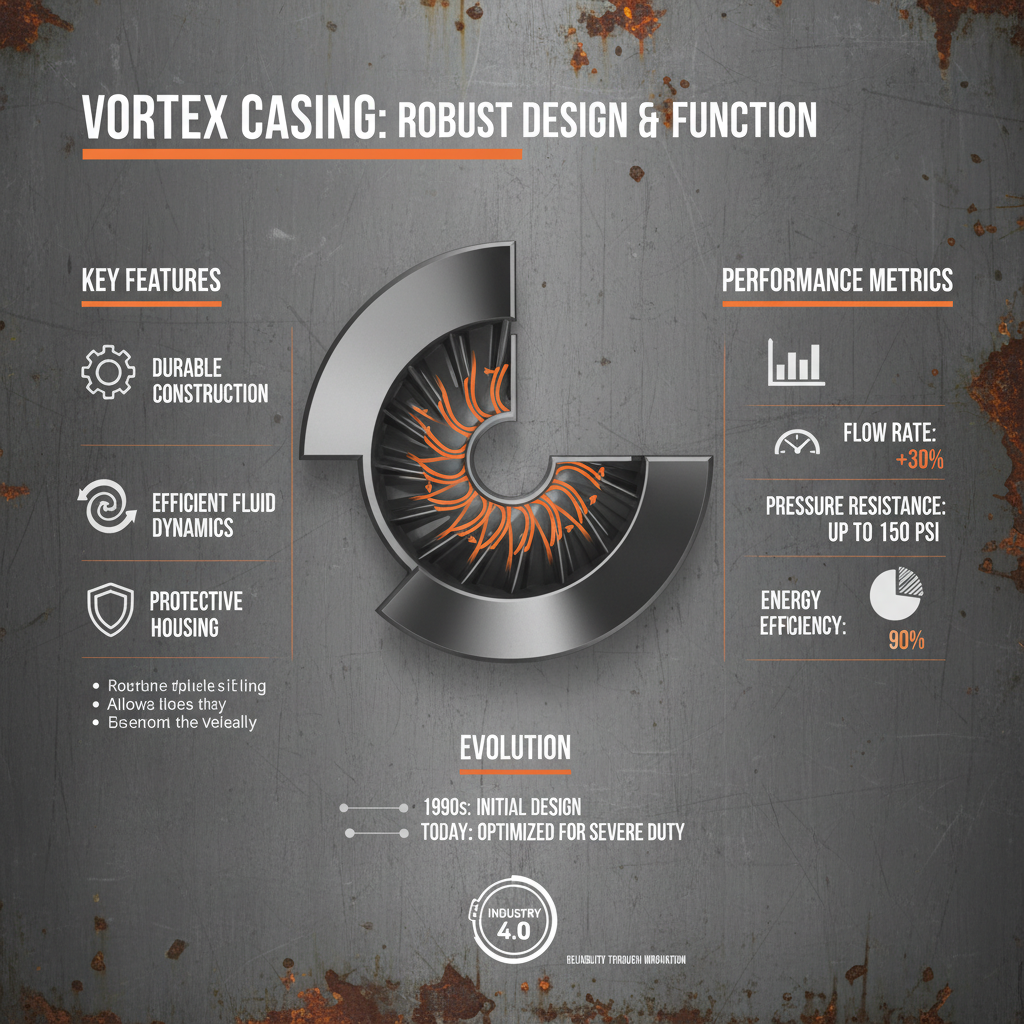
Durability is another key characteristic. Vortex casing is often constructed from robust materials like stainless steel or high-grade polymers to withstand corrosive environments and high operating pressures. This ensures a long service life and minimizes maintenance requirements. The material selection process is tailored to the application and the fluids being handled.

Finally, the versatility of vortex casing is noteworthy. It can be customized to accommodate a wide range of flow rates, fluid types, and operating conditions. This adaptability makes it a suitable solution for diverse industrial applications, offering a flexible and efficient fluid handling approach.

Performance Factors of vortex casing

The performance of vortex casing is heavily influenced by several key factors. Inlet velocity plays a critical role in establishing the initial vortex strength. Higher inlet velocities generally lead to stronger vortexes, but can also increase energy losses if not properly managed.

Casing geometry is also paramount. The shape and dimensions of the casing significantly impact vortex stability and separation efficiency. Optimized designs minimize turbulence and maximize the residence time for effective separation.

vortex casing Performance Comparison


Global Applications of vortex casing

Vortex casing finds widespread application in the wastewater treatment industry. It efficiently removes sand, grit, and other debris from influent water, protecting downstream equipment and improving treatment process performance. This is especially crucial in municipal and industrial wastewater plants.

In the oil and gas sector, vortex casing is utilized for oil-water separation, removing contaminants from produced water before discharge or reuse. This contributes to environmental compliance and resource conservation.

The Long-Term Value Proposition of vortex casing

The benefits of implementing vortex casing extend far beyond initial cost savings. Reduced maintenance requirements, stemming from the robust design and durable materials, translate into lower lifecycle costs. This leads to significant financial advantages over the long term.

From a sustainability perspective, vortex casing contributes to responsible resource management. By improving separation efficiency and reducing waste, it minimizes environmental impact and promotes a circular economy. The long-term value lies in its contribution to both economic and ecological well-being.

The reliability of vortex casing provides operational peace of mind. Consistent performance and minimal downtime ensure continuous process operation, maximizing productivity and reducing the risk of costly disruptions.

Future Trends in vortex casing Technology

Ongoing research and development efforts are focused on optimizing vortex casing designs through computational fluid dynamics (CFD) modeling. This allows for precise tailoring of casing geometry to specific fluid properties and operating conditions, maximizing efficiency and minimizing energy losses.

The integration of smart sensors and data analytics is another emerging trend. Real-time monitoring of vortex characteristics allows for predictive maintenance and optimized process control. This proactive approach enhances system reliability and reduces operational costs.

The development of new materials, such as advanced polymers and composites, is expanding the application range of vortex casing. These materials offer enhanced corrosion resistance, increased durability, and lighter weight, making vortex casing suitable for even more demanding environments.

Summary of Key Vortex Casing Development Areas

Development Area Current Status Potential Impact Investment Level (1-10)
CFD Modeling Widely adopted for design optimization Significant efficiency gains and reduced development time 8
Smart Sensor Integration Pilot projects demonstrating feasibility Predictive maintenance, optimized process control 6
Advanced Material Development Research phase exploring novel polymers Expanded application range, increased durability 7
Miniaturization of vortex casing Emerging trend for microfluidic applications New opportunities in diagnostics and lab-on-a-chip devices 5
Bio-inspired vortex casing designs Initial studies mimicking natural vortex formations Potential for highly efficient and adaptable systems 4
Additive Manufacturing (3D Printing) Increasingly used for prototyping and custom designs Rapid prototyping, complex geometries, reduced lead times 7

FAQS

What are the primary benefits of using vortex casing compared to traditional separation methods?

Vortex casing offers several advantages over traditional separation methods like sedimentation or filtration. It typically requires less energy, has a smaller footprint, and can handle higher flow rates. Furthermore, vortex separators often exhibit reduced maintenance requirements due to the lack of moving parts, leading to lower operational costs and increased reliability. The ability to separate a wider range of particle sizes effectively is another key benefit.

What types of materials are commonly used in the construction of vortex casing?

Common materials for vortex casing construction include stainless steel, particularly 304 and 316 grades, for their corrosion resistance and durability. High-density polyethylene (HDPE) and polypropylene (PP) are also frequently used, offering cost-effectiveness and good chemical resistance. Material selection depends heavily on the specific application, the fluids being handled, and the operating environment. Certain applications may also utilize specialized alloys or composite materials.

How do I determine the appropriate size and configuration of a vortex casing for my application?

Determining the correct size and configuration involves several factors. Key parameters include the flow rate, the particle size distribution of the solids to be separated, the density difference between the solids and liquids, and the desired separation efficiency. Computational Fluid Dynamics (CFD) modeling is often employed to optimize the casing geometry for specific conditions. Consulting with experienced vortex casing manufacturers or engineers is highly recommended.

What is the typical maintenance schedule for a vortex casing system?

Vortex casing systems generally require minimal maintenance. Regular inspections for wear and tear, particularly on inlet and outlet structures, are recommended. Periodic cleaning to remove accumulated solids may be necessary, depending on the application and the nature of the fluids being processed. Monitoring performance parameters, such as pressure drop, can help identify potential issues early on and prevent more significant problems.

Can vortex casing be retrofitted into existing fluid handling systems?

Yes, in many cases, vortex casing can be successfully retrofitted into existing systems. However, a thorough assessment of the existing infrastructure is crucial to ensure compatibility and proper integration. Factors such as available space, pipe configurations, and flow rate limitations must be considered. A professional engineering evaluation is highly recommended to determine the feasibility and optimize the retrofit design.

What are the typical cost considerations associated with vortex casing solutions?

The cost of a vortex casing system varies based on factors such as size, materials of construction, complexity of the design, and specific application requirements. While the initial investment may be higher than some traditional separation methods, the long-term operational savings due to reduced energy consumption, lower maintenance, and increased efficiency often result in a favorable return on investment. A comprehensive lifecycle cost analysis is advisable.

Conclusion

Vortex casing represents a significant advancement in fluid handling technology, offering a compelling combination of efficiency, durability, and versatility. From its core principle of utilizing controlled vortex action for separation and mixing to its diverse applications across industries like wastewater treatment, oil & gas, and chemical processing, it's clear that vortex casing is a key enabler of sustainable and optimized industrial operations.

Looking ahead, continued innovation in materials, modeling techniques, and sensor integration will further enhance the performance and broaden the applicability of vortex casing. Embracing these advancements will be essential for organizations seeking to improve efficiency, reduce environmental impact, and maintain a competitive edge. To learn more about how vortex casing can benefit your operations, visit our website: www.ydcastings.com

Joseph Baker

Joseph Baker

Joseph Baker is a Project Engineer at Hebei Yuanda Trade Co., Ltd., dedicated to managing customized metal part projects from initial inquiry to final delivery. He works closely with customers to understand their specific requirements and translates those needs into detailed manufacturing specifications. Joseph is particularly knowledgeable in molten mold
Previous The Critical Role of Stainless Steel Pipe Cap in Modern Industries
Next Optimizing Pump Performance with Advanced Pump Volute Casing Designs