English

0%

Table of Contents

Centrifugal pump volute casing plays a critical role in a vast array of industries, from water management and agriculture to oil and gas, and even power generation. These casings are essential components, directly influencing pump efficiency, reliability, and overall performance. Understanding the nuances of their design, manufacturing, and application is therefore paramount for engineers, technicians, and anyone involved in fluid handling systems. The global market for centrifugal pumps, and consequently the demand for high-quality volute casings, is substantial and continually growing.

The increasing global population, coupled with growing industrialization and the urgent need for sustainable water resource management, drives the demand for efficient and robust pumping solutions. Simultaneously, stringent environmental regulations are pushing manufacturers to optimize pump designs for reduced energy consumption and improved operational lifespan – areas where the volute casing design significantly impacts performance. The effective design and implementation of a centrifugal pump volute casing is no longer simply a mechanical problem, it’s an economic and environmental necessity.

Furthermore, advancements in materials science and manufacturing techniques, such as 3D printing and computational fluid dynamics (CFD), are revolutionizing the possibilities for centrifugal pump volute casing design, leading to optimized geometries and improved performance characteristics. This evolution is not merely about incremental improvements; it’s about creating entirely new classes of pumps tailored to specific and demanding applications.

Centrifugal Pump Volute Casing Design Applications and Future Trends

Introduction to Centrifugal Pump Volute Casing

Centrifugal Pump Volute Casing Design Applications and Future Trends

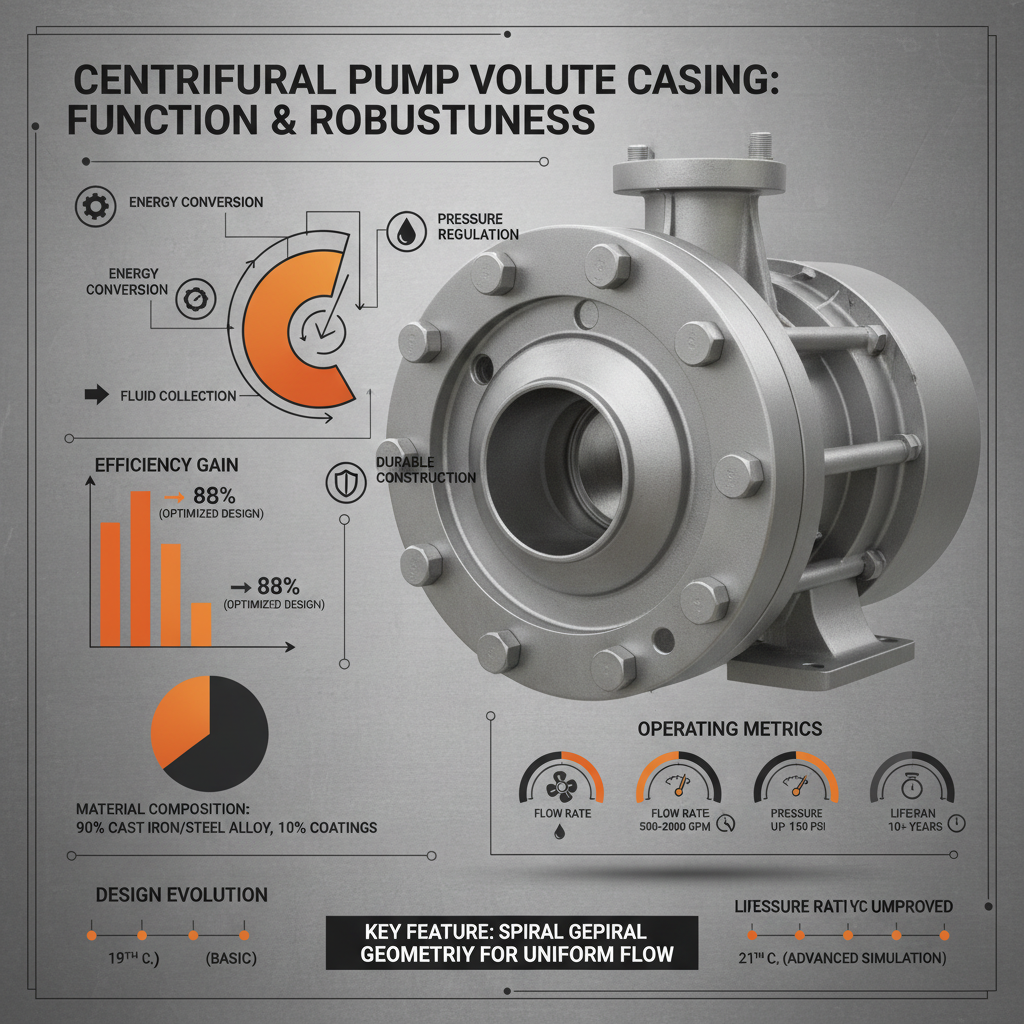
A centrifugal pump volute casing serves as the housing that surrounds the impeller, collecting the fluid discharged by the impeller and converting velocity energy into pressure energy. This process is fundamental to the pump's operation, and the casing’s geometry plays a crucial role in determining its efficiency. Without an effectively designed volute casing, even the most powerful impeller would fail to deliver optimal performance.

The design of the centrifugal pump volute casing is a delicate balance between fluid dynamics, structural integrity, and manufacturing feasibility. Its shape isn't arbitrary; it's carefully engineered to minimize energy losses and maximize pressure development. Materials selection is also key, factoring in corrosion resistance, temperature tolerance, and the specific fluid being pumped.

Defining the Centrifugal Pump Volute Casing

Simply put, a centrifugal pump volute casing is the spiral-shaped housing surrounding the impeller of a centrifugal pump. Its primary function is to collect the fluid discharged by the impeller and efficiently convert the kinetic energy (velocity) of the fluid into potential energy (pressure). This conversion happens as the fluid travels through the progressively expanding cross-sectional area of the volute.

The volute casing isn't merely a container; it's an integral part of the pump's hydraulic design. Its carefully sculpted geometry minimizes turbulence and energy losses, leading to a higher overall pump efficiency. This makes the volute casing critical for applications where energy conservation and cost-effectiveness are paramount.

Modern industry and humanitarian needs rely heavily on efficient fluid transfer. From providing clean water to communities to facilitating industrial processes, centrifugal pumps and their volute casings are indispensable. The efficiency gains offered by optimized volute casing designs directly translate into reduced energy consumption and lower operational costs, benefiting both businesses and the environment.

Core Aspects of Volute Casing Design

Several key factors define the effectiveness of a centrifugal pump volute casing. Firstly, hydraulic efficiency is paramount. This refers to minimizing energy losses as the fluid flows through the casing, primarily achieved through a smooth, gradually expanding volute shape. The casing must be designed to handle the fluid volume and velocity without creating excessive turbulence or flow separation.

Secondly, structural integrity is critical. The casing must withstand the internal pressure generated by the pump and external forces during operation. Material selection and wall thickness are vital considerations. The casing's design must also account for potential stresses caused by thermal expansion and contraction.

Thirdly, manufacturability plays a significant role. Complex geometries can be hydraulically efficient but may be difficult and expensive to manufacture. Modern casting techniques and the rise of 3D printing are pushing the boundaries of what’s possible, but cost-effectiveness remains a key driver. Finally, corrosion resistance is vital, particularly when handling abrasive or corrosive fluids; appropriate material selection is therefore critical for longevity.

Practical Applications Across Industries

Centrifugal pump volute casings are ubiquitous across a diverse range of industries. In water and wastewater treatment, they are crucial for moving large volumes of water through filtration systems and distribution networks. Similarly, in agriculture, they are used for irrigation and fertilizer application.

The oil and gas industry relies on robust volute casings for transferring crude oil, refined products, and process fluids. In power generation, they are essential for cooling water circulation and boiler feedwater pumps. The automotive industry also utilizes centrifugal pumps with volute casings for coolant circulation and hydraulic systems.

Comparative Analysis of Volute Casing Design Methods


Advantages and Long-Term Value

The advantages of utilizing well-designed centrifugal pump volute casings are multifaceted. From a cost perspective, efficient casings reduce energy consumption, lowering operational expenses. Sustainability is enhanced through minimized energy usage and prolonged pump lifespan, reducing the need for frequent replacements.

The reliability provided by robust casings minimizes downtime and maintenance, ensuring continuous operation in critical applications. Furthermore, advanced designs contribute to increased safety by reducing the risk of failures and leaks. The longevity of these casings also translates to a lower total cost of ownership over the pump’s lifespan.

Future Trends in Volute Casing Technology

The future of centrifugal pump volute casing design is being shaped by several key trends. Additive manufacturing (3D printing) is enabling the creation of complex geometries previously impossible to achieve with traditional methods, leading to optimized hydraulic performance.

Advanced materials, such as composite materials and high-performance alloys, are being explored to enhance corrosion resistance, reduce weight, and improve structural integrity. Furthermore, the integration of digital twins and AI-powered design optimization is accelerating the development of innovative and efficient casing designs.

Challenges and Innovative Solutions

Despite advancements, several challenges remain. One major hurdle is cavitation, the formation of vapor bubbles within the pump, which can damage the volute casing. Innovative solutions include optimizing impeller and casing geometries to reduce pressure drop and employing anti-cavitation materials.

Another challenge is erosion caused by abrasive particles in the fluid. Hard coatings and wear-resistant materials are being used to mitigate this issue. Furthermore, improving manufacturing precision and employing advanced non-destructive testing methods are crucial for ensuring the long-term reliability of volute casings.

Finally, balancing hydraulic efficiency with structural strength and manufacturability remains a constant challenge, necessitating sophisticated design tools and a deep understanding of fluid dynamics and materials science.

Summary of Key Challenges and Solutions in Centrifugal Pump Volute Casing Design

Challenge Severity (1-10) Potential Solution Implementation Cost (1-10)
Cavitation 8 Optimized impeller/casing geometry 6
Erosion 7 Hard coatings/wear-resistant materials 5
Structural Failure 6 Improved material selection/design validation 7
Manufacturing Complexity 5 Additive manufacturing/simplified designs 8
Corrosion 9 Corrosion-resistant alloys/coatings 6
Hydraulic Inefficiency 7 CFD optimization/advanced geometries 7

FAQS

What are the primary materials used in centrifugal pump volute casing construction?

Common materials include cast iron, stainless steel, and various alloys chosen for their corrosion resistance, strength, and cost-effectiveness. Cast iron is often used for general-purpose applications, while stainless steel is favored in corrosive environments. Alloy selections depend heavily on the fluid being pumped and the operating temperature and pressure conditions. The goal is to balance performance characteristics with long-term durability and cost.

How does the volute casing shape affect pump efficiency?

The volute casing shape is critical to pump efficiency. A properly designed spiral shape gradually increases in cross-sectional area, allowing the fluid to decelerate smoothly and convert velocity energy into pressure energy. A poorly designed casing can create turbulence and flow separation, leading to energy losses and reduced efficiency. Computational Fluid Dynamics (CFD) analysis is often used to optimize the volute shape for specific flow conditions.

What is cavitation, and how can it be prevented in volute casings?

Cavitation occurs when the pressure within the pump drops below the vapor pressure of the liquid, causing vapor bubbles to form and collapse violently. This can damage the volute casing and impeller. Prevention methods include increasing the net positive suction head available (NPSHa), reducing the pump speed, using an inducer, and optimizing the impeller and casing geometry to minimize pressure drop.

How does 3D printing impact centrifugal pump volute casing manufacturing?

3D printing, or additive manufacturing, allows for the creation of complex volute casing geometries that are difficult or impossible to produce with traditional methods. This enables optimized hydraulic designs for improved efficiency. 3D printing also allows for faster prototyping and customized solutions tailored to specific applications. However, material limitations and cost considerations remain challenges.

What are the typical inspection methods used to ensure the quality of a volute casing?

Typical inspection methods include visual inspection for surface defects, dimensional checks using coordinate measuring machines (CMMs), non-destructive testing (NDT) such as ultrasonic testing and radiographic testing to detect internal flaws, and hydrostatic testing to verify pressure integrity. These inspections ensure the casing meets required standards and will perform reliably in service.

How do you select the right volute casing material for a specific application?

Material selection depends on factors like the fluid being pumped (corrosive, abrasive, etc.), operating temperature, pressure, and cost. Stainless steel is often chosen for corrosive fluids, while cast iron is suitable for water. High-alloy materials are used for extreme conditions. A thorough understanding of the application requirements and material properties is crucial for making the right selection, balancing performance with longevity and budget.

Conclusion

The centrifugal pump volute casing is far more than a simple housing; it's a critical component that directly impacts pump efficiency, reliability, and overall performance. From optimizing hydraulic design to leveraging advanced materials and manufacturing techniques, ongoing innovations are continually pushing the boundaries of what’s possible, leading to more sustainable, cost-effective, and robust pumping solutions for a wide range of industries. Understanding the core principles and emerging trends surrounding the volute casing is vital for professionals involved in fluid handling systems.

Looking ahead, continued advancements in computational modeling, additive manufacturing, and materials science promise even greater improvements in volute casing design. Prioritizing research and development in these areas will not only enhance pump performance but also contribute to a more sustainable and efficient future for industries reliant on fluid transfer. To learn more about high-quality centrifugal pump volute casings, visit our website: www.ydcastings.com.

David Chen

David Chen

David Chen serves as the Quality Control Manager at Hebei Yuanda Trade Co., Ltd., bringing a rigorous approach to ensuring product excellence. With a background in material science, David oversees all inspection processes, from raw material sourcing to final product assessment. He’s a key driver in maintaining our commitment to
Previous Optimizing Pump Performance with Advanced Pump Volute Casing Designs
Next Essential Water Pump Hose Connector Guide for Efficient Fluid Transfer Systems