English

Mobile:+86-311-8081-2683
Email:info@ydcastings.com
English
impeller and turbine
Impeller and Turbine An Exploration of Fluid Dynamics
In the realm of fluid dynamics, impellers and turbines play pivotal roles across various industries, from aerospace to power generation. As mechanical components designed to convert energy from one form to another, both impellers and turbines serve distinct functions, yet they share some fundamental principles of operation.
An impeller is a rotating component within a pump that is used to increase the pressure and flow of a fluid. The primary function of an impeller is to impart kinetic energy to the fluid it moves. When the fluid enters the impeller, it is directed into the rotating blades, which propel it outward and increase its velocity. This increase in kinetic energy is then converted into pressure energy as the fluid exits the impeller and moves into the volute or casing of the pump. Impellers are commonly found in various applications, including centrifugal pumps, jet engines, and HVAC systems, where the efficient movement of fluids is essential.
Impeller and Turbine An Exploration of Fluid Dynamics
In contrast, turbines are devices designed to extract energy from a flowing fluid, most commonly water, steam, or gas. The purpose of a turbine is to convert the kinetic energy of the fluid into mechanical energy, which can then be harnessed to perform work, such as generating electricity. As the fluid flows over the turbine blades, it causes the rotor to spin, ultimately driving a generator or performing other desired tasks. Turbines are widely utilized in hydroelectric plants, thermal power plants, and even in wind energy systems.
impeller and turbine
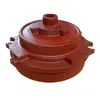
Similar to impellers, the design of a turbine blades is crucial. Turbine blades are typically designed to optimize the angle and curvature to maximize energy extraction while minimizing losses due to drag. Different types of turbines, such as impulse turbines and reaction turbines, operate on varying principles. Impulse turbines generate energy from the momentum of a high-speed fluid jet acting on the blades, whereas reaction turbines rely on the pressure drop across the blades to produce motion. This difference highlights the diverse methodologies employed in harnessing energy from fluids.
Despite their differing functions, impellers and turbines are interconnected in many systems. For instance, in a combined cycle power plant, both an impeller and a turbine may be utilized in the same system—where the impeller pumps water to create steam, which then drives the turbines to generate electricity. Such interdependence illustrates the importance of integrating these components effectively for optimal system performance.
In recent years, advancements in materials and technology have led to innovations in both impeller and turbine designs. The introduction of lightweight composites, 3D printing, and advanced computational techniques have facilitated the development of more efficient, durable, and cost-effective devices. Moreover, the pursuit of sustainability and efficiency has pushed engineers to explore new designs that minimize energy consumption and reduce environmental impact.
In conclusion, impellers and turbines are fundamental components in a variety of industries, each playing a crucial role in the management and conversion of energy. Understanding their designs, functions, and the principles underlying their operation is vital for engineers and scientists alike. As technology continues to evolve, we can expect exciting developments in these fields, with the potential to create more efficient systems that align with the global push for energy sustainability. The synergy between impellers and turbines will remain a cornerstone in the continuing advancement of fluid dynamics applications.
-
Choosing an Engine Storage Crate Cover for Material and EnvironmentNewsNov.23,2026
-
Cylinder Head Chamber Buyers: Check the Casting Specification FirstNewsNov.17,2026
-
How Impeller Casting Manufacturers Match Material, Process and EquipmentNewsNov.15,2026
-
Valve body vs. intake air chamber: Which casting fits your assembly?NewsNov.02,2026
-
Air Intake Chamber FAQ: Specifications, Ordering and Support QuestionsNewsOct.28,2026
-
Motorcycle Accessories FAQ: Specifications, Ordering and Support QuestionsNewsOct.24,2026










